
Yesterday, South Africans took to the polls to vote in the fifth fully inclusive democratic elections of our long, complicated history. On AWOL City cycle tour we delve into the past as we cycle to the Parliament Buildings in Cape Town and unravel the democratic story of our city and brightly coloured South African flag.
As the Apartheid system crumbled 20 years ago, a new flag had to be designed to fly high over the ‘new’ country. The current South African flag was first flown on the 27th of April 1994. Barely making it onto the nation’s flagpoles in time for the election, when Mandela became president (on May 10th). Upon Mandela’s release from prison in 1990, it was decided that a new flag was part of the negotiation process. A public competition was held in 1993 with over 7,000 designs being suggested. None of these flags were chosen. Eventually the issue came down to chief negotiators of the ANC (African National Congress) and the NP (National Party) to resolve the issue timely before the elections.
[fusion_builder_container hundred_percent=”yes” overflow=”visible”][fusion_builder_row][fusion_builder_column type=”1_1″ background_position=”left top” background_color=”” border_size=”” border_color=”” border_style=”solid” spacing=”yes” background_image=”” background_repeat=”no-repeat” padding=”” margin_top=”0px” margin_bottom=”0px” class=”” id=”” animation_type=”” animation_speed=”0.3″ animation_direction=”left” hide_on_mobile=”no” center_content=”no” min_height=”none”]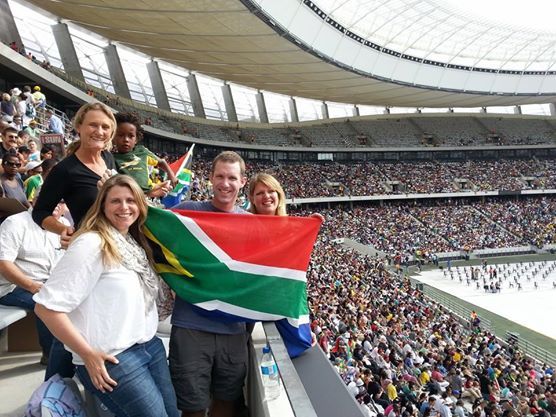
The iconic flag was designed by State Herald Fred Brownell. The design and colour is a synopsis of the principal elements of the country’s flag history – being red, white and blue from the Dutch and British communities. The black, green and gold represent the flags of the liberation movements (ANC, Inthaka and PAC). Although different people may attribute personal symbolism to the individual colours or colour combinations, no symbolism should be attached to any of the colours. The only symbolism in the flag is the Y shape, which can be interpreted as the blending of diverse elements within South African society. The Y shape converging into the road of unity.
The fifth one-person, one-vote general elections prove that South Africa is very well on its way functioning as a modern democracy. Unique in this election, is that the people born after apartheid (the so called ‘born free’) had the opportunity to vote for the first time. As expected, the ANC has cruised to a large victory – despite numerous scandals by the heads of the party. The DA (Democratic Alliance), however, has grown significantly nearly gaining a quarter of the votes (back in 2009 they only managed 16, 4%). Also, new kid on the block, former ANC Youth League leader Julius Malema has gained around 5% of the votes with his controversial EFF (Economic Freedom Party). An impressive feature for a new party. Former wife of Steve Biko, Dr. Mamphela Ramphela has failed to make any impression, not finding a seat in parliament at all.
Whilst celebrating twenty years of democracy in South Africa, join us on AWOL’s City Cycle Tour to learn more about the old and new Political history of South African Democracy.
[/fusion_builder_column][/fusion_builder_row][/fusion_builder_container]